Questions
Answers
Why choose Premier Polytunnels?
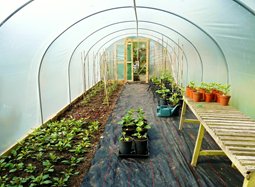 When a bird goes “cheep” it wants attention. When a polytunnel goes cheap it needs attention! A ‘Premier’ polytunnel, however, just stands there quietly year after year while you tend your plants. Quality is not cheap, but it does offer excellent value! To buy cheap is to buy twice.
The quality and materials of our polytunnels cannot be matched. Our specialist and improved design is the only one to include all of the following as standard:
- Larger diameter hoops than other models
- 5-layer Thermal Anti Drip polythene cover
- Wide ‘wheelbarrow’ doors
- Universal fixing brackets for ease of construction.
We are a family business with more than 35 years experience and we are experts in polytunnel design and development – A Rolls-Royce trained engineer, our senior designer and developer is the man responsible for bringing you many of the polytunnel design innovations since 1991, including Anchor Plates which have been successfully used for many years and are now used by many other companies.
All of our polytunnels, cloches, and fruit and veg cages are manufactured in-house by our highly skilled and experienced team and are regularly updated and tested on our design and development site.
But we don’t just offer the highest quality product at a great price – We also understand the importance of offering a ‘Premier’ service, including after sales support.
Premier Polytunnels are proud to be the ONLY polytunnel company to offer an out of hours Construction Advice Helpline, 7 days a week until 9pm. And when you contact us you can be sure to speak to the boss!
Our polytunnels are a great investment which will last the grower for years and years, so why not visit our Show Site in Lancashire to see and feel the quality of our products for yourself, meet the team and pick our brains. You can also click here to see what our customers say about us.
Back to Top
What does a standard kit include?
All ‘Premier’ polytunnels are supplied as a complete unit ready for assembly onto a soil base. Our standard kits include an all-steel polytunnel frame – made from Z35 high tensile galvanised steel and using large diameter steel hoops for extra strength and rigidity – including foundation tubes, hoops, corner stabilisers, and ridge. Kits for garden polytunnels include a timber door frame and hinged door at the front end and a timber end frame with a dummy door at the rear end, and kits for commercial polytunnels include timber door frames and hinged double doors at each end. All kits also include Anti Hot Spot Tape and a full Thermal Anti Drip polytunnel cover.
A full range of additions are also available and are highly recommended to enable you to customise and enhance your polytunnel to suit the needs of your chosen plants. Additions include Anchor Plate kits, Crop Bar kits, Storm Strengthening kits, Triple Ridge kits, and Timber Base Rail kits or Aluminium Base Rail kits. Take a look at the video below which details the different polytunnel covering options available, and pop over to our YouTube channel to watch videos showing all of the available additions.
All of our polytunnels, cloches, and fruit and veg cages are manufactured in-house by our highly skilled and experienced team, and are regularly updated and tested on our design and development site.
Back to Top
Why is there a big price difference between some polytunnel suppliers?
?width=255&height=149) It is important to remember when comparing prices that “you only get what you pay for”. The tunnels available on auction websites or pre-packed on the shelves of garden centres for around £100.00 are only suitable to be used as temporary covers for short periods of time on sheltered sites; they will not stand up to being placed on a permanent site because of the lack of structural stability and the unsuitable polythene covers.
It is important to remember when comparing prices that “you only get what you pay for”. The tunnels available on auction websites or pre-packed on the shelves of garden centres for around £100.00 are only suitable to be used as temporary covers for short periods of time on sheltered sites; they will not stand up to being placed on a permanent site because of the lack of structural stability and the unsuitable polythene covers.
“Real” polytunnels vary in price depending on what is included in a standard kit, for example; the size of steel hoops, the type of polythene cover and doors/end frames, VAT, and delivery charges – Always check before you buy and don’t miss those extra charges!
There is no such thing as a "like for like" comparison with a 'Premier' polytunnel – The quality and materials of our polytunnels cannot be matched.
Back to Top
Do they blow away?
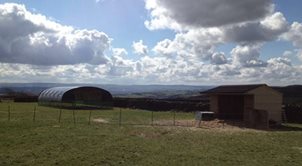
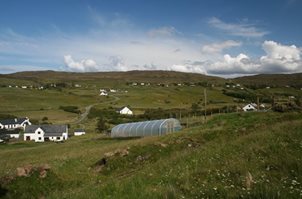
No. It is a common misconception that a piece of polythene stretched over a frame could never resist a British winter. However, commercial growers, whose livelihoods depend on polytunnels, would not accept a structure that disappeared over the nearest hill in a gust of wind just when their tender shoots are at their most susceptible.
Many customers tell us that they need a strong polytunnel as it is extremely windy where they live. We are confident that if built according to the instructions, resulting in a structure that is firmly anchored to the ground and, most importantly, with the polythene cover as taut as possible, a ‘Premier’ polytunnel will give many years of uninterrupted use.
We have been supplying polytunnels for many years throughout the whole of the UK, including the Scottish Highlands and Islands, and to very exposed, hilly locations.
For those sites exposed to extreme weather conditions, we recommend purchasing Anchor Plates, Base Rails, Crop Bars, Triple Ridges, and P Clips to act as Storm Strengthening collars.
Back to Top
What can they be used for?
A polytunnel is designed for use as a plastic greenhouse and should be used to nurture plants just as you would in a glasshouse. However, over the years their uses have covered a multiple of customer requirements and if you can think of anything that requires protection from the elements, then a polythene tunnel is an economical alternative. Swimming pool covers and sheep houses are popular alternatives.
Back to Top
What is the life expectancy of a polytunnel?
There is no reason why our polytunnel frames, which are all made from Z35 high tensile galvanised steel tube, would not last 20 years and more. The polytunnel cover will need replacing periodically, although the polythene supplied by Premier Polytunnels has been developed with resistance against polythene’s deadliest enemy – sunlight. The additives in a polytunnel cover prevent UV degradation for up to 4-5 years and it is not uncommon for a cover to last 8-10 years. The cost of replacement polytunnel covers is minimal.
Back to Top
What happens if my polythene tears?
The polythene used for polytunnel covers is very strong and will not readily tear or split. Puncture holes can appear when contact with a sharp object occurs, but splits do not radiate outwards from these holes as they do with glass. Tears are easily repaired with a UV resistant polytunnel repair tape and there is no reason why the cover will not last its full term.
Back to Top
Can I heat my polytunnel?
Yes. You can heat a polytunnel the same as you would heat a glasshouse. Heat must not be directed at the polytunnel plastic. Gas, electric, solid fuel, free standing or suspended heating units are all suitable. Using fleece and bubble insulation, sectioning off an area inside, or using a Polythene Cloche to "double glaze" your polytunnel will reduce heating costs.
Back to Top
Can I harvest rainwater from my polytunnel?
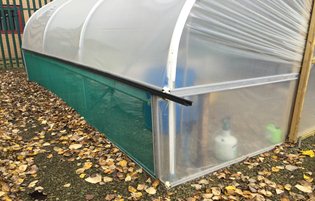 Yes. We understand how important water is to our customers and therefore we have designed a specialist water collection system for your polytunnel.
Our polytunnel gutters are designed to be used in conjunction with our timber or aluminium side rails. On aluminium side rails the gutter simply slots into the aluminium rail. For fitting to timber side rails, a gutter carrier is screwed to the timber rail and the polytunnel gutter simply slots into place. A stop end slots into the gutter at one end or, if you prefer, you can position the stop end at any point along the gutter and collect water at each end of your tunnel. Water can be collected in a water butt or vessel of your choice.
Long-lasting and aesthetically pleasing, our polytunnel gutters require no maintenance other than clearing them of debris occasionally.
Harvesting rainwater from a polytunnel provides an independent water supply during regional water restrictions, meaning that you can keep watering your plants during the summer months. It is also often used to supplement the main supply.
Collecting rainwater is an easy, cost effective way of ensuring you can always keep watering.
Back to Top
How will my polytunnel be delivered?
Garden polytunnels are usually delivered in disassembled bundles and boxes via a national freight courier. A standard 10ft x 20ft polytunnel would typically consist of 8 packages. The longest length of any package delivered with a garden polytunnel is 8ft (or 10ft if you have double sliding doors) and with an approx diameter of 6in, meaning that you can have your polytunnel delivered to your home address, then transport it to your allotment in your car on a day that suits you.
Most commercial polytunnels will be delivered by a courier on 1-2 pallets measuring up to 3.6m long. Large commercial polytunnels can weigh more than 1000kg. The goods are strapped onto the pallet in bundles which are manageable by hand and can be handballed off the pallet if no lifting equipment is available at the delivery address. (Please note, if no lifting equipment is available, it will be necessary for a minimum of 2 people to be available at time of delivery to assist with unloading the goods).
Please Note: Delivery is made by a national courier and we recommend that customers are at the delivery address on the day of delivery.
For delivery lead times, please see our Delivery page.
Back to Top
How long will it take to arrive?
Your garden polytunnel will normally be dispatched in 1-3 working days of placing an order, however this may increase to approx 10-15 working days (excluding weekends and Bank Holidays) during busy periods. A commercial polytunnel is normally dispatched in 3-5 working days of placing an order, however this may increase during busy periods. Please see our Delivery page for up-to-date dispatch times when placing your order.
We will contact customers by e-mail (or telephone, if requested) to advise them when their order has left our warehouse. Premier Polytunnels will endeavour to accommodate any special delivery requests, however we cannot guarantee a specific date or time. Please Note: Delivery is made by a national courier and we recommend that customers are at the delivery address on the day of delivery.
Delivery is FREE to England, Wales and most areas of Scotland. Some areas of the Scottish Highlands and offshore destinations in Great Britain will incur a delivery surcharge. Please see our Delivery page for further details.
If you have any queries or questions regarding delivery, please do not hesitate to contact us.
Back to Top
What is the 5-layer technology used in Premier Polytunnels' polythene films?
Sophisticated polythene films contain a number of special chemical additives which make up the many properties of the films. These include light diffusion, stabilisation against UV breakdown, thermal and anti drip properties, blocking of ultra violet radiation, anti mist, and others. In addition, the films are often produced using more than one base resin.
Until the introduction of multi-layer extruders more than 25 years ago, the additives and resins were all mixed in together in the one and only layer that was available at the time.
However, among the additives there are those which are incompatible or, when mixed together, give undesirable results such as haziness or reduced transparency. It was recognised that for a polythene film to be as efficient as possible it was necessary for a particular additive to perform on the upper or lower layer of the film and not randomly wherever it was found.
 The multi-layer co-extrusion technology (first 2-layers and, later, 3-layers) allowed polythene producers, to a certain extent, to place materials where they need to be. It also allowed them to separate particular additives that were incompatible into different layers.
In 2001, Premier Polytunnels’ polythene extruders installed the first large-size 5-layer extruder, allowing the additives within the film to be divided more evenly still – making for an even more efficient polytunnel cover.
Back to Top
Is the timber used Forest Stewardship Council approved?
Yes, all the timber supplied by Premier Polytunnels is FSC approved and is always traceable back to source. The batten we use is Scandinavian soft wood and is tanalised. Other timber used is soft wood tanalised (green) timber from Scandinavia or Scotland. All the timber is pressure treated with a wood preserver to protect against rot.
Back to Top
Do I need planning permission?
Generally you do not need planning permission for a domestic size/garden polytunnel. However, there are sometimes exceptions to the permitted development regulations (the rules for what does and does not need planning permission), therefore it is always best that you contact your local planning authority if you have any doubts.
If the polytunnel meets with any of the following criteria, you should contact your local planning department to determine if planning permission is required (it will not be required in all cases):
- If the polytunnel would have any part forward of the front of the house.
- If it is more than 3m in height.
- If it would be within 2m of the boundary of the site and would be more than 2.5m in height.
- If it results in more than 50% of the area around the house being covered by buildings or structures that was not part of the original house.
Planning permission may be required if the site on which you intend to construct the polytunnel has a listed building or is in a Conservation Area, a National Park, an Area of Outstanding Natural Beauty, or the Norfolk or Suffolk Broads – There are further restrictions to planning within these areas.
If the polytunnel would be for commercial use or any other use that is not "incidental to the enjoyment of the dwelling house".
If you want to build a large commercial polytunnel or more than one tunnel, or if you have any queries or questions, please contact your local planning department for further advice.
If you are thinking of ordering an allotment polytunnel, you may need to check with the allotment committee which may have specific rules about the sizes of polytunnels allowed.
For further information about planning permission, please click here.
Manufacturer Specifications and Scale Drawings available from Premier Polytunnels on request.
If you want to build a Sheep House Polytunnel for use as an agricultural building on your farm, you do not need planning permission for farming operations and if there are permitted development rights on the farm.
You will usually need planning permission if the plans for your farm meet with any of the following criteria:
- If you want to change how you use your land or buildings from farming to something else.
- If you want to build a house on the land.
- If you are applying for a grant for a project that needs a building or other development.
For further information about planning permissions for farms, please click here.
Back to Top
I still have a question.
Please do not hesitate to contact us by e-mail at info@premierpolytunnels.co.uk or by telephone on 01282 811250. We will be happy to answer any further queries or questions you may have regarding our polytunnels, polytunnel accessories, and polythene covers.
We also have a list of construction-based FAQ's here.
Back to Top